

Description
Article no.: AS13 2716
Product Information
|
Immunogen |
Synthetic peptide chosen from human Amyloid-Beta protein (3-10) region, oligomer specific. |
|
Host |
Mouse |
|
Clonality |
Monoclonal |
|
Subclass/isotype |
IgG1, kappa light chain, (clone number 2D10.F6) |
|
Purity |
Affinity purified |
|
Format |
Lyophilized |
|
Quantity |
50 µg |
|
Reconstitution |
For reconstitution add 50 µl of sterile water. |
|
Storage |
For short time storage please add sodium azide and srote at +4°C. |
|
Tested applications |
Dot Blot (Dot), ELISA (ELISA), Immunolocalization (IL) |
|
Recommended Dilution |
10 ug/ml (IL), 1-2 ug/ml (Dot), 2-4 ug/ml (ELISA capture) |
|
Expected | apparent MW |
4.5 kDa |
Reactivity
|
Confirmed Reactivity |
Human |
|
Not reactive in |
No confirmed exceptions from predicted reactivity are currently known. |
Application Examples
|
Application examples |
Dot blot 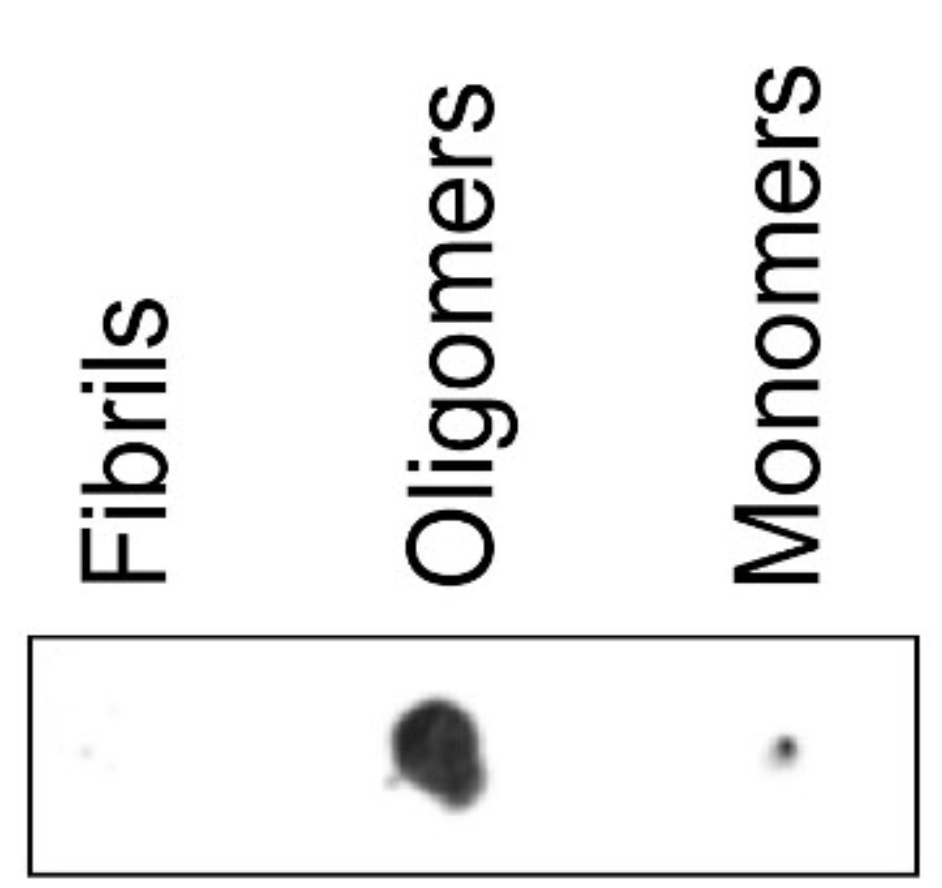
Dot blot reaction of the binding capacity of mAB-M to fibrils, monomers and oligomers. Equal amounts of each sample were spotted on a nitrocellulose membrane and then dried. The membrane was blocked with 5% non-fat milk before incubated for 1 h with anti-mAB-M (25nM) and then with secondary antibody, anti-mouse HRP-conjugated (1:1500). The membrane was washed with PBS containing 0.25% Tween-20 before detection using ECL prime (GE Healthcare). Immunolocation 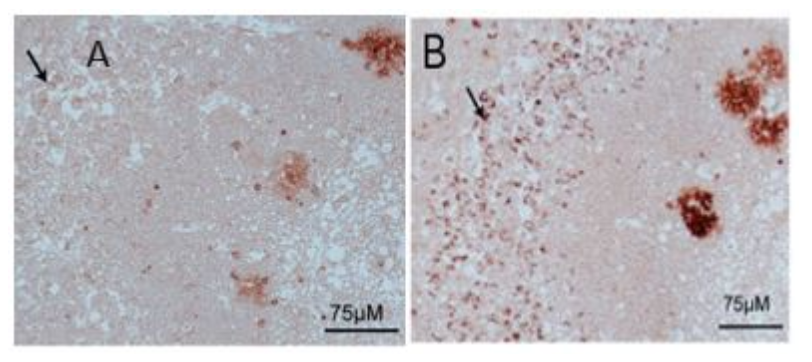
IHC used to illustrate the lack of binding of mAB-M to plaques. Tissue sections from the human AD hippocampus were de-waxed and rehydrated in ethanol and then incubated with AS08 357 (A) and mAB-M(B) at RT for 1h. The immunoreactivity was detected with the anti-mouse Peroxidase Reagent Kit (ImmPRESS, Vector Laboratories, Inc.) and then developed using the ImmPACT AEC Peroxidase Substrate kit (Vector Laboratories, Inc.). |
Additional Information
|
Additional information |
Due to location of antigen used to elicit this antibody in 3-10 region, it should bind to full length APP |
Related Products
|
Related products |
Background
|
Background |
Alzheimer's disease (AD) is the most prevalent neurodegenerative disease in the growing population of elderly people. A hallmark of AD is the accumulation of plaques in the brain of AD patients. The plaques predominantly consist of aggregates of amyloid-beta (Abeta), a peptide of 39-42 amino acids generated in vivo by specific, proteolytic cleavage of the amyloid precursor protein. Recent findings however suggest that smaller oligomeric forms of Abeta, formed in parallel to the amyloid plaques, excert the predominant tissue damaging effect. |
Product Citation
|
Product citations |
Brännström et al. (2014). A Generic Method for Design of Oligomer-Specific Antibodies. PLoS ONE. DOI: 10.1371/journal.pone.0090857. |