


Description
Article no.: AS08 357
Product Information
|
Immunogen |
Synthetic peptide chosen from human Abeta (1-42) protein. Amino acid sequence: |
|
Host |
Rabbit |
|
Clonality |
Polyclonal |
|
Purity |
Serum |
|
Format |
Lyophilized |
|
Quantity |
100 µg |
|
Reconstitution |
Add 100 ul sterile water to reconstitute to 1 mg/ml |
|
Storage |
Store lyophilized/reconstituted at -20°C; once reconstituted make aliquots to avoid repeated freeze-thaw cycles. Please, remember to spin tubes briefly prior to opening them to avoid any losses that might occur from lyophilized material adhering to the cap or sides of the tubes. |
|
Tested applications |
Dot Blot (Dot), ELISA (ELISA), Western blot (WB) |
|
Recommended Dilution |
1 : 1000 (Dot), 1 : 3000 (ELISA), 1 : 1000 (WB) |
|
Expected | apparent MW |
4.5 kDa |
Reactivity
|
Confirmed Reactivity |
Human |
|
Predicted Reactivity |
Bovine, Chicken, Dog, Porcine, Rabbit |
|
Not reactive in |
No confirmed exceptions from predicted reactivity are currently known. |
Application Examples
|
Application examples |
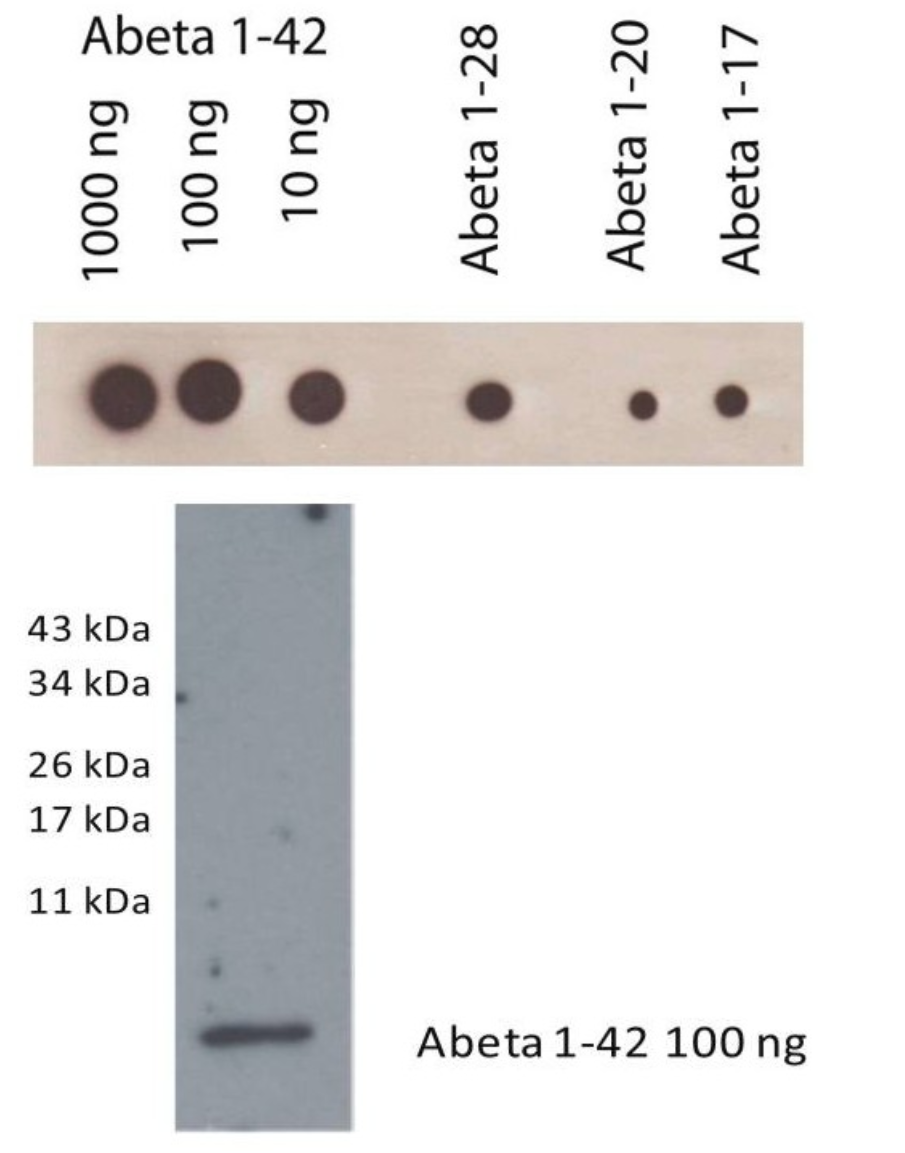
Dot blot and Western analysis
 |
Additional Information
|
Additional information |
The antibody can detect Abeta(1-42), Abeta(1-28) Abeta(1-20) and Abeta(1-17). |
Related Products
|
Related products |
Background
|
Background |
Alzheimer's disease (AD) is the most prevalent neurodegenerative disease in the growing population of elderly people. A hallmark of AD is the accumulation of plaques in the brain of AD patients. The plaques predominantly consist of aggregates of amyloid-beta (Abeta), a peptide of 39-42 amino acids generated in vivo by specific, proteolytic cleavage of the amyloid precursor protein. |